

Hackatons
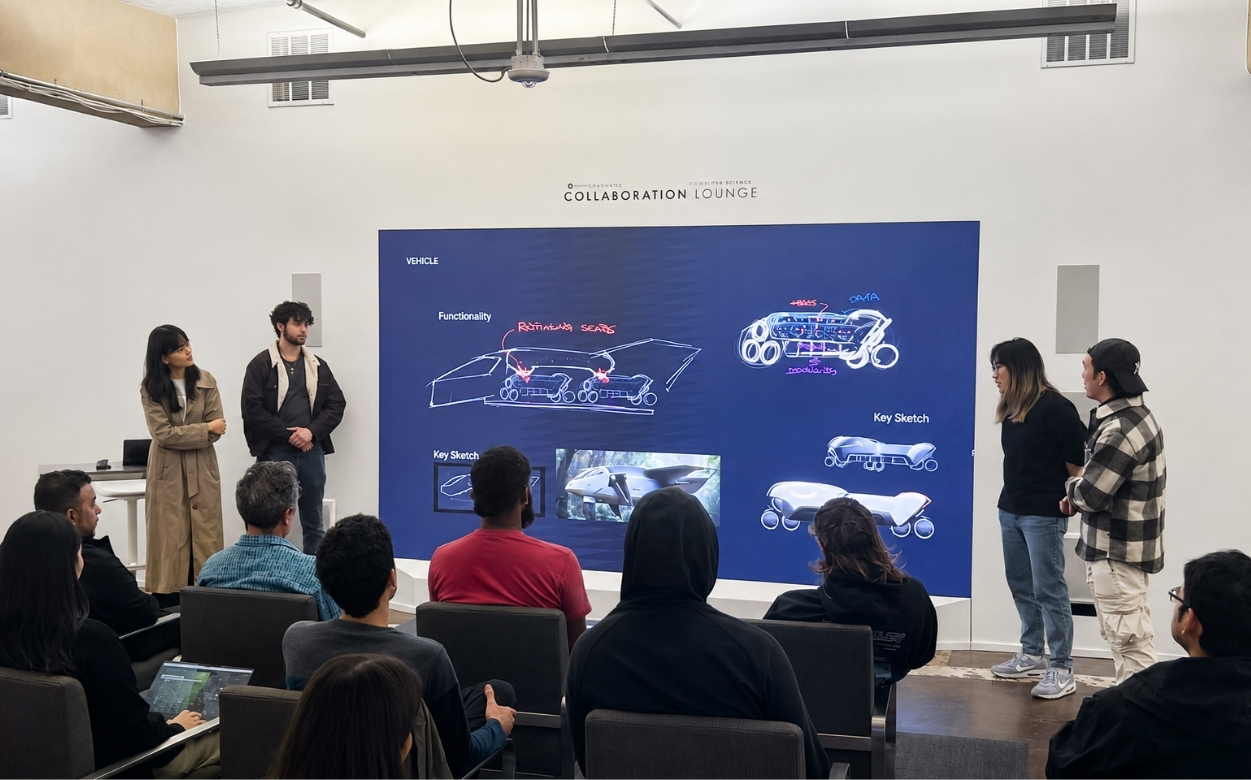
Creative hackathons organized by Lemme
Between 2024 and 2025, Lemme developed a series of creative hackathons aimed at investigating the use of Generative Artificial Intelligence (GenAI) in creative processes. In total, five experiments are part of the master’s research by Gustavo Modena, conducted within the Graduate Program in Engineering and Knowledge Management at UFSC, under the guidance of Professor Júlio Monteiro Teixeira, leader of Lemme.
The proposal sought to observe, in practice, how students in creative fields appropriate GenAI tools during the development of solutions. In this experimental environment, it was possible to closely monitor fundamental stages, such as ideation, prompt engineering, testing, decision-making, and project presentation. In each activity, participants were organized into groups and challenged to create proposals in a short amount of time. Themes included issues such as the preservation of the Amazon Rainforest, health and well-being, urban mobility, ergonomics, sustainability, and the future of education.
Part of the experiments also had an international dimension, connecting UFSC researchers to benchmark institutions such as the Academy of Art University in San Francisco. In this collaboration, students developed innovative solutions such as:
- Transportable bicycle: focused on efficient urban mobility.
- Wrist warmer: aimed at well-being and ergonomics.
- “Lara” project: developed in California by approximately 20 students; the game converts the planting of trees in a virtual environment into real donations for the reforestation of the Amazon.


The experiments involved researchers Melise Peruchini, Gustavo Modena, and Gabriel Albrecht, in addition to coordination by Professor Júlio Monteiro Teixeira. In different editions, the proposals were evaluated by jurors connected to the creative industry and national and international institutions.

Researchers involved in the hackathon experiments
Gustavo’s master’s dissertation details each of these experiments minutely, offering an in-depth analysis of the technical and creative appropriation of GenAI tools. In general, the research indicates that Generative AI acted primarily as a mediator of the creative process, contributing to expanding possibilities, accelerating tests, and supporting the visualization of ideas.

Timeline of the experiments conducted in the research
The central decisions, however, remained with the students, especially in defining the concepts, narratives, and paths of the solutions.
With the hackathons, Lemme consolidates an investigative front aimed at understanding how emerging technologies permeate education and practice in the creative industry. The initiative is continuously expanding: in addition to the five experiments analyzed in the dissertation, two new hackathons have already been held, and other editions are planned to expand the research on GenAI in concrete creative contexts.
Details on the methodology, the results of each experiment, and in-depth reflections on the use of AI in design are available in Gustavo Modena’s master’s dissertation, titled The use of Generative Artificial Intelligence in creative hackathons: experimentation and mediation. The work has already been defended and can be accessed in full in the UFSC Institutional Repository at the link: https://repositorio.ufsc.br/.


